Your pets will be fine. That's the honest answer we give every Winter Park homeowner who calls before scheduling a duct sealing appointment, and it deserves to be stated plainly before anything else.
Central Florida HVAC systems run year-round in a way most of the country's don't. That continuous operation puts real stress on duct joints. The thermal cycling between Florida's outdoor heat and an air-conditioned interior gradually works connections loose over years of use. Air duct sealing in Winter Park addresses that problem at the source, using a process far less aggressive than most homeowners imagine when they hear the word "sealant." After serving thousands of homes across Orange County, we haven't documented a single adverse pet reaction when standard preparation steps were followed. What matters is understanding why — and what responsible preparation looks like for your specific household.
TL;DR Quick Answers
Is air duct sealing safe for pets in Winter Park homes?
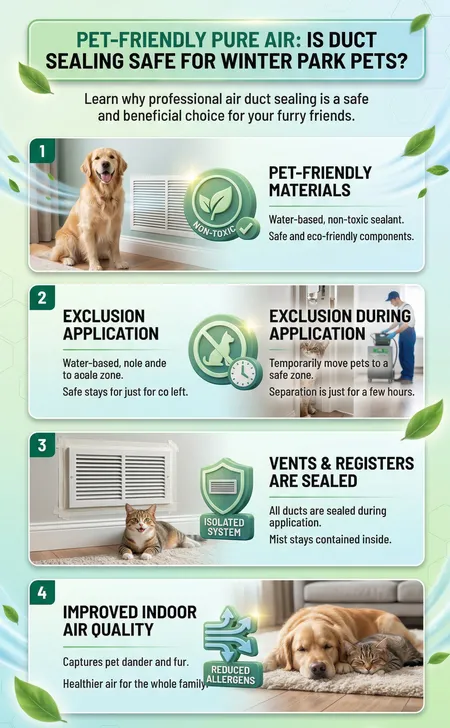
Yes. Professional air duct sealing in Winter Park uses a water-based, low-VOC polymer that poses no documented risk to household pets when standard preparation steps are followed.
What to know:
Remove pets for the full service window (4 to 6 hours)
Dogs and cats can return after 2 hours of post-service ventilation
Birds and small mammals need 24 hours away from the home
The process uses no harsh solvents, open flames, or caustic adhesives
Sealed ducts improve indoor air quality for pets by stopping dander from recirculating through the system with each HVAC cycle
A MERV 11 or MERV 13 filter amplifies the benefit in pet-owning households
Top Takeaways
Air duct sealing in Winter Park is safe for pets when a qualified, NATE-certified technician performs the work and standard preparation steps are followed.
Remove pets from the home for the full service window (typically 4 to 6 hours) and allow at least 2 hours of post-service ventilation before dogs and cats return.
Birds and small mammals need a full 24 hours away from the home after service — their respiratory systems are significantly more sensitive than a dog's or cat's.
Leaky ducts redistribute pet dander through every room with each HVAC cycle. Sealing them stops that redistribution at the source.
Pair duct sealing with a MERV 11 or MERV 13 air filter for the strongest indoor air quality improvement in a pet-owning household.
How Air Duct Sealing Works — and Why the Process Matters for Pets
The Aeroseal Process in Plain Terms
Aeroseal is the professional standard for duct sealing, and understanding how it actually works takes most of the concern out of the equation.
Here's what service day looks like:
A technician pressurizes the duct system and seals off all registers and vents throughout the home.
That same technician then injects a water-based polymer mist — the same base compound found in low-VOC interior paints and school adhesives — into the system under controlled pressure.
Polymer particles travel through the airstream and adhere to leak edges, layering until each gap closes.
The material cures inside the duct and becomes inert and odorless.
The technician generates a before-and-after leakage report on-site so you can see the measurable improvement.
The process uses no harsh chemicals, open flames, or solvent-based adhesives and stays contained within the duct system throughout.
Why Winter Park Homes Are Particularly Good Candidates
Central Florida homes log more HVAC run hours per year than almost any other market in the country. That continuous cycling puts steady pressure on duct joints — particularly in homes built between the 1970s and early 2000s, where older flex duct tends to separate at collar connections over time. The result: a system working harder than it should, with Duke Energy and OUC bills that reflect every wasted BTU. From what we've seen across service calls throughout Winter Park and surrounding Orange County communities, leaky duct systems are among the most overlooked contributors to poor indoor air quality in pet-owning homes.
Is the Sealant Safe for Dogs, Cats, and Other Animals?
What the Material Is — and Is Not
The vinyl acetate polymer in Aeroseal is not an industrial chemical. It contains no formaldehyde, no heavy metals, and none of the VOC types found in traditional adhesives or spray sealants. Once it cures inside the duct system, the material is chemically stable and odorless.
During the active injection phase, the compound is airborne inside the ducts. That's why we keep pets and people out of the home during the service window — not because the compound is acutely toxic, but because any active HVAC service warrants the same precautions as painting a room or refinishing a floor. Common sense, applied consistently.
Special Consideration: Birds and Small Mammals
Dogs and cats handle minor air quality fluctuations without issue. Birds, guinea pigs, rabbits, and other small mammals don't. Their respiratory systems are highly sensitive and can react to even low-level airborne compounds that a dog or a person would tolerate without any effect.
Our recommendation for these pets is clear: plan for a 24-hour absence after service completes, not just the standard 2-hour post-ventilation window. The American Veterinary Medical Association offers the same guidance for any interior treatment involving airborne compounds in the home.
How to Prepare Your Pets for Duct Sealing Day
Taking these steps before your appointment makes the process smooth for everyone in the household.
Arrange for pets to stay with a neighbor, at a boarding facility, or in a climate-controlled vehicle for the full service window.
Remove food bowls, water dishes, bedding, and toys from rooms with accessible floor or wall registers.
Tell your technician about any pets with known respiratory conditions before the appointment starts — brachycephalic breeds like bulldogs and pugs, cats like Persians, birds, and small mammals should all be mentioned.
Plan for at least 2 hours of post-service ventilation with windows open before dogs and cats come back inside. Birds and small mammals need the full 24 hours.
Run your HVAC through one full cycle after ventilation to confirm normal airflow before settling pets in.
In our experience, homeowners who follow these steps don't report any disruption to their animals at all. It's the same level of preparation we'd recommend before any professional interior service.
The Indoor Air Quality Benefit for Pet-Owning Homes
Here's something most pet owners don't consider until it's pointed out: leaky ducts actively work against your animals, not just your energy bills.
Every time the HVAC cycles, conditioned air escapes through duct leaks and unconditioned air pulls back in from attic spaces, crawl spaces, or wall cavities. That replacement air carries whatever lives in those spaces — mold spores, construction dust, and the oak and citrus pollen that blanket Central Florida for most of the year. At the same time, pet dander circulates back through every room via those same leaking joints, with each cycle, all day. Sealing the ducts breaks that loop. Pair the service with a MERV 11 or MERV 13 air filter and you've made one of the highest-impact investments a pet-owning household can make for long-term indoor air quality.
"In our years of servicing HVAC systems across Central Florida, the homes that struggle most with indoor air quality are almost always the ones with significant duct leakage — and in pet households, that leakage acts like a dander distribution system running 24 hours a day. Sealing those ducts is one of the most straightforward, high-impact improvements we can make for the health and comfort of the entire family, pets included."
Essential Resources
1. U.S. EPA — Indoor Air Quality (IAQ)
The EPA's central hub for indoor air quality guidance covers pollutant sources, ventilation standards, and health effects for residential and commercial buildings. A useful starting point for any homeowner researching HVAC system performance and its impact on the air inside their home.
https://www.epa.gov/indoor-air-quality-iaq
2. U.S. EPA — Should You Have the Air Ducts in Your Home Cleaned?
This EPA consumer guide walks through what duct cleaning and sealing actually involve, what the evidence says about when it helps, and what to ask a service provider before hiring them. Useful for homeowners trying to separate well-supported claims from marketing language.
https://www.epa.gov/indoor-air-quality-iaq/should-you-have-air-ducts-your-home-cleaned
3. ENERGY STAR — Duct Sealing
ENERGY STAR's duct sealing resource explains how duct systems lose efficiency over time, why sealing them matters for home comfort, and how to find qualified contractors. Published by the U.S. Environmental Protection Agency's energy efficiency program.
https://www.energystar.gov/saveathome/heating-cooling/duct-sealing
4. ENERGY STAR — Benefits of Duct Sealing
A focused breakdown of what properly sealed ducts actually deliver: efficiency gains, lower utility bills, and reduced risk of backdrafting from combustion appliances. Includes the program's documented finding that leaky ducts can cut HVAC efficiency by up to 20 percent.
https://www.energystar.gov/saveathome/heating-cooling/duct-sealing/benefits
5. Asthma and Allergy Foundation of America — Pet Allergies
The AAFA covers how pet dander and other animal allergens behave inside the home, what triggers reactions, and which environmental controls make a measurable difference. Helpful context for pet-owning households managing indoor allergen loads.
https://aafa.org/allergies/types-of-allergies/pet-dog-cat-allergies/
6. American Veterinary Medical Association — Household Hazards for Pets
The AVMA's household hazards guide addresses how common home products and treatments — including airborne compounds and cleaning agents — affect pets differently than people. The section on inhaled particles is directly relevant to any interior service that temporarily introduces compounds into the air.
https://www.avma.org/resources-tools/pet-owners/petcare/household-hazards
Supporting Statistics
1. Leaky ducts can reduce HVAC efficiency by up to 20%. ENERGY STAR confirms that leaky ducts can cut a home's heating and cooling efficiency by as much as 20 percent. For Winter Park homeowners running their systems year-round, that efficiency loss compounds across every month of the calendar — not just a seasonal peak. Sealed ducts recover that performance, and the difference shows up quickly on monthly utility bills.
Source: ENERGY STAR — Benefits of Duct Sealing
2. The EPA connects sealed duct systems directly to IAQ improvement. The EPA identifies duct leakage as a direct contributor to indoor air quality problems, pointing out that leaks in return ducts draw contaminants from unconditioned spaces directly into the supply air stream. In homes where pet dander and hair are already present throughout the system, a sealed duct system is an IAQ priority, not just an efficiency upgrade.
Source: U.S. EPA — IAQ in Schools (HVAC Systems)
3. Pet dander is one of the most common indoor allergen triggers in U.S. households. The Asthma and Allergy Foundation of America identifies pet dander as a leading indoor allergen source. In homes with leaky ductwork, that dander circulates through every room with each HVAC cycle rather than getting caught at the filter. Duct sealing paired with a high-MERV filter breaks that distribution cycle at the mechanical level.
Final Thoughts and Opinion
We've answered this question more times than we can count, and we're always glad when homeowners ask it. It reflects the kind of careful, protective thinking that builds a well-maintained home.
Here's our honest read after years of work across Central Florida: the concern about duct sealing and pet safety is real, but preparation resolves it. Aeroseal is not a harsh chemical treatment. It's a precision service, professionally controlled, and when the right precautions are in place, it leaves every living thing in the home — people and pets — breathing cleaner air than before.
The homes we've seen with the worst indoor air quality for animals are rarely the ones that just had their ducts sealed. They're the ones that haven't had duct service in years, running a leaky distribution system that cycles allergens, dander, and outdoor particulate through every room, every hour of every day. Addressing duct leakage is not a risk to your pets. Years of ignoring it is.
If you have birds or small mammals, build in that 24-hour buffer without exception. For dogs and cats, standard prep and post-service ventilation covers it. The result — cleaner air, lower utility costs, and a more comfortable home — benefits everyone under that roof.
Frequently Asked Questions
Q1: Is Aeroseal duct sealant toxic to dogs and cats?
No. Aeroseal uses a water-based vinyl acetate polymer — the same base compound found in low-VOC interior paints. Once it cures inside the duct system, the material is inert and odorless. The recommendation to remove pets during the service window follows the same logic as any interior treatment involving airborne compounds: clear the space while work is underway, ventilate properly, then bring everyone back in.
Q2: How long should my pets stay out of the home after air duct sealing?
For dogs and cats, we recommend a minimum of 2 hours after service completion and post-ventilation. For birds, guinea pigs, rabbits, and other small mammals, plan for 24 hours. Their respiratory systems are built differently, and the extra buffer is worth it.
Q3: Will duct sealing help with pet allergies in my Winter Park home?
Yes — often more than homeowners expect. Leaky ducts push pet dander through every room with each HVAC cycle instead of allowing the filter to catch it. Sealed ducts change that equation. Combine the sealing service with a MERV 11 or MERV 13 filter and you'll see a real difference for anyone in the household managing allergies.
Q4: How do I know if my Winter Park home needs duct sealing?
Watch for uneven room temperatures, energy bills that keep climbing without explanation, dust that reappears on surfaces shortly after cleaning, and an HVAC system that runs almost constantly without hitting the thermostat set point. Homes built in the 1970s through the early 2000s are especially prone to duct leakage — the material aging, combined with the wear that comes from year-round operation in Central Florida's heat and humidity, adds up over time.
Q5: Does duct sealing require a licensed professional?
Yes. Aeroseal requires specialized pressurization equipment and trained technicians — it's not a DIY process. A certified technician measures leakage before and after the service and provides a verified improvement report on-site. Confirm any HVAC provider's Florida license at MyFloridaLicense.com before booking.
Ready to Breathe Easier — Pets and All?
Schedule your Winter Park duct sealing assessment and find out exactly how much conditioned air and indoor air quality your home has been losing. Your whole household will notice the difference.
Here is the nearest branch location serving the Winter Park area. . .
Filterbuy HVAC Solutions
2900 Titan Row # 128, Orlando, FL 32809
(407) 204-1859
https://maps.app.goo.gl/Weuf8AhtuRP4H855A
